GET RECENT UPDATES, POSTS & ARTICLES
Blogs

Marathon President Poudel Highlights Nepal’s Potential for Sports and Tourism while meeting AIMS President Paco Borao President Ramchandra Poudel emphasized that Nepal is a fertile ground for sports and tourism, with the potential to host various types of running
Join Dhara Nepalgunj Marathon 2024
<p>Nepalgunj Marathon is the mega race event of Nepal which is organized on the rememberance of peace treaty which ended a decade long civil war leading for peace and growth in the country.</p> <p><strong>Race Date</strong> : 7th Dec 2024</p> <p><strong>Start address:</strong> Nepalgunj, Nepal</p> <p><strong>Finish address:</strong> Nepalgunj 21900, Nepal</p> <p><strong>What's included</strong></p> <ul> <li>Finisher Medal</li> <li>Event T-shirts</li> <li>E-Certificate/e-diploma</li> <li>Cash Prizes</li> <li>Timing chip (single use)</li> <li>Video Service</li> <li>Post-race meal</li> <li>Drink Stations</li> <li>Medical Assistance</li> <li>Toilets</li> <li>Dressing rooms</li> <li>Accident insurance</li> </ul> <p> </p>
Read More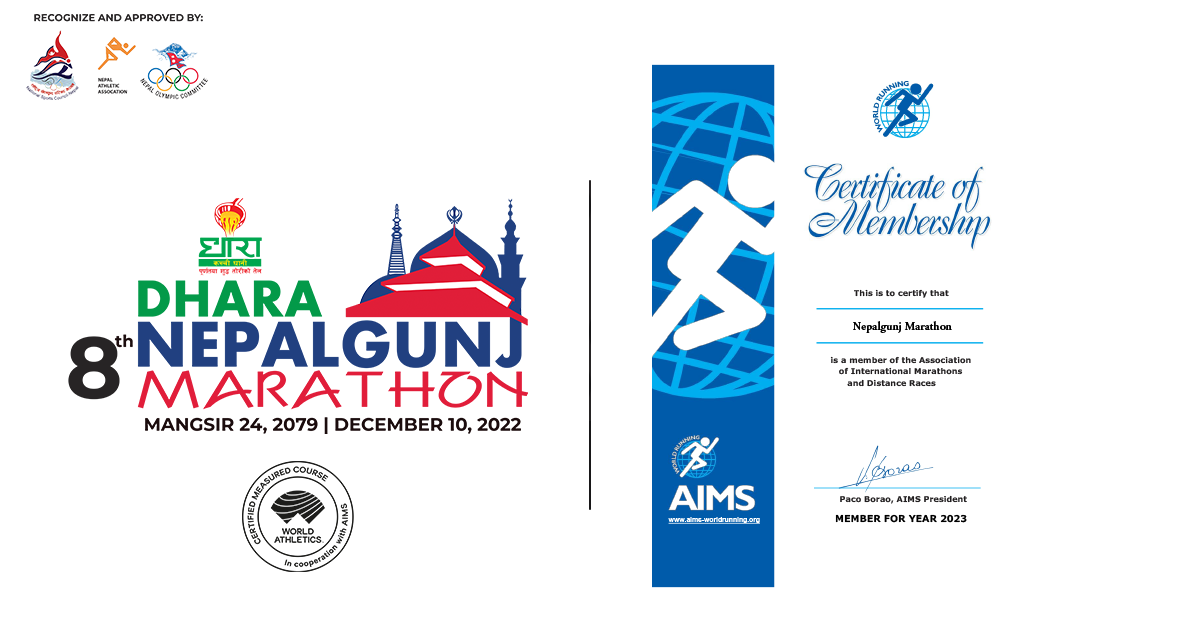
President Poudel Highlights Nepal’s Potential for Sports and Tourism while meeting AIMS President Paco Borao President Ramchandra Poudel emphasized that Nepal is a fertile ground for sports and tourism, with the potential to host various types of running Marathon
Nepalgunj Marathon granted with AIMS Membership
<p><strong>Nepalgunj Marathon has been granted with the membership of the highest body of world marathons, the Association of International Marathon and Distance Race (AIMS).</strong></p> <p><img alt="" src="https://www.hamrokhelkud.com/en/wp-content/uploads/2022/10/nepalgunj-marathon-aims-certificate-1024x576.jpg" style="height:576px; width:1024px" /></p> <p>The eighth edition of the Nepalgunj Marathon, scheduled to be held on 10th December, received AIMS certification for the 42.195 KM marathon, 21.097 KM half marathon, 10 KM, and 5 KM races in September.</p> <p>AIMS granted the Nepalgunj Marathon membership as it completed all the required qualifications. Nepalgunj Marathon received the certificate of Membership signed off by AIMS president Paco Borao last week.</p> <p><img alt="" src="https://www.hamrokhelkud.com/en/wp-content/uploads/2022/10/nepalgunj-marathon-certificate-aims-714x1024.jpg" style="height:1024px; width:714px" /></p> <p>The Nepalgunj Marathon consists of ten different categories. In the competition, men’s marathon (42.195 km), women’s half marathon (21 km), 10 km men’s open, 5 km women’s open, 5 km school level students, 3 km school level students, kids run (8 to 12 years old), 2 km corporate run, 1 km tricycle and walkathon are included. School-level races will be held within Banke district students only.</p>
Read More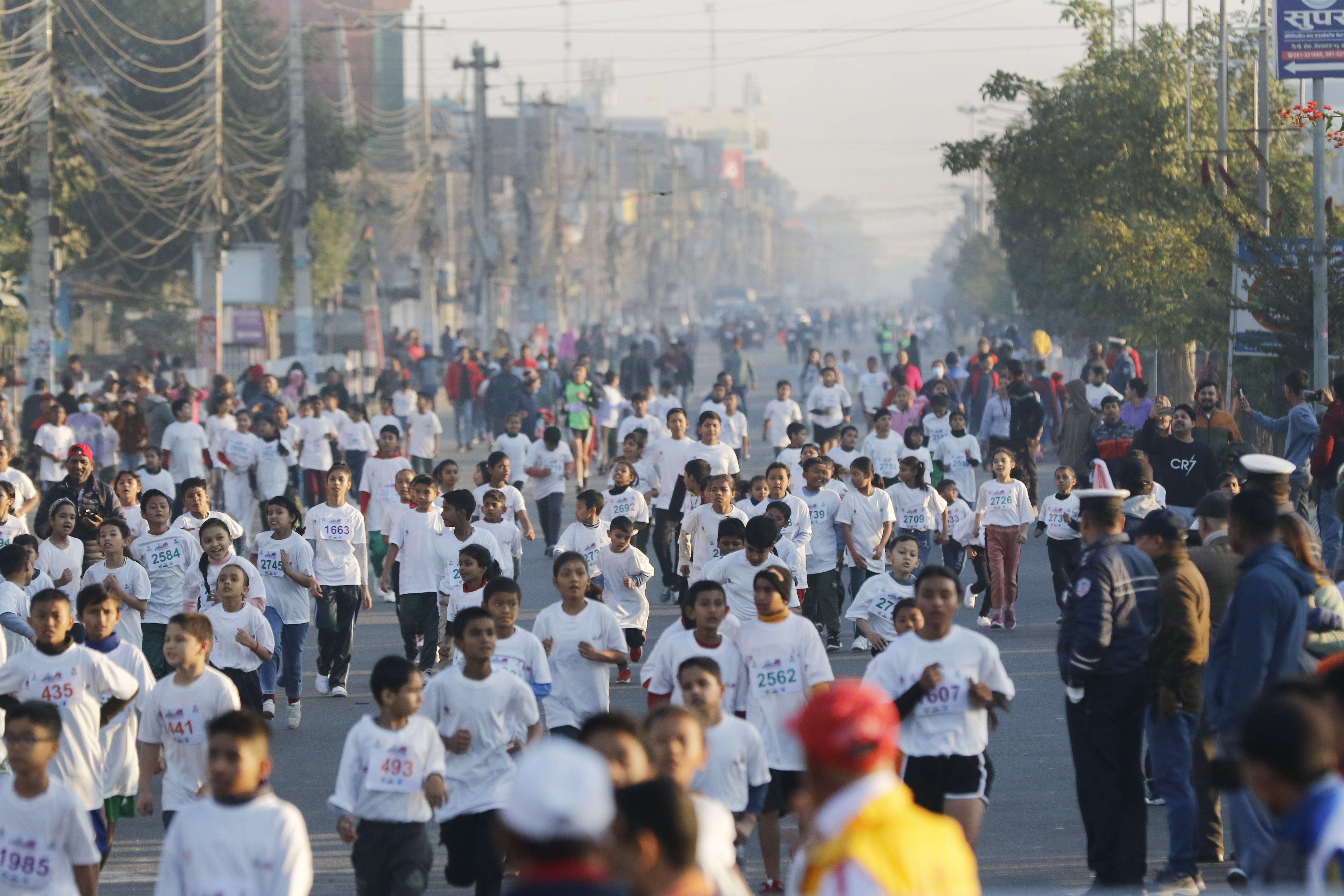
Marathon
Nepalgunj Marathon following the history
<p> </p> <p>A wise debate sparked in the 13th South Asian Games held in Nepal. And the topic was about the first gold medalist for the South Asian Game history. As the history of the game starts from the Nepal in 1984, the first Gold won by country has vital meaning. The problem is created when we lacked the historical facts about SAAF. Despite all adverse situations we were determined to find it.</p> <p>Even among the players participating in the same competition, there was no consensus. In between the cumbersome working period, we found that Nepal won four gold medals in that South Asian Game .One in athletics, two in boxing and one in the football. The gold from the football certainly was not first, many speculated that the athletics gold won from the marathon was probably not the first, because usually this race is also at the end of such big competitions. Finally, the news published on Gorkhapatra resolved all confusions. Contrary to all predictions, the marathon held at the very beginning of the first South Asian Games. The name first Gold winner was our legendary Baikuntha Manandhar. Baikundha sir himself was not sure about the fact that he was first to grab that title. However, he finished the race in 2 hours 27.11 minutes and became first.</p> <p>This medal has more significance from a different point of view and it is the first medal won by Nepal in an official competition in the entire sports history. That's why it has a great historical meaning. Manandhar did not stop at this South Asian Games, he won gold in three consecutive editions, including in 1985 and 1987. Third SAAF Game held in Kolkata, India. From Nepal's point of view, Manandhar's hat-trick of gold medals will be remembered for this tournament. Perhaps there is another point of view to make it more historical and this is the record set by Manandhar while winning gold. He completed the race in 2 hours 15.03 minutes. This is the only South Asian athletics record so far, which is held by a Nepalese athlete. So far no one has been able to break it.</p> <p>Nepali sports will rarely get a player like Manandhar again and again. This is also the most known name in Nepali sports. He remained a symbol of Nepali sports for a long time. He played not one, not two, but four Olympics. Which is still a record. Manandhar is a historical player in many ways. Now, the Nepali marathon may not live without him. Due to this aura created by Baikuntha Manandhar competing players also praise his way of running and further they proud on him and his ways.</p> <p><strong>Marathon as First Game in many </strong></p> <p>In 1951, New Delhi, India hosted the first Asian Games. Those were the days when the whole world was not like it is now. From politics to social structure, everything was different. Nepal also participated in the same competition. This is the first biggest sports festival that Nepal has participated in. A total of 10 players from Nepal are believed to have participated in this tournament. Who were these players? We don't have the exact answer. This is the problem of not writing history on time. At least as far as we know, one player who will be participating is Gajraj Joshi. Therefore, he is also considered as the first historical international player of Nepal. Interestingly Joshi participated in the Asian Games in the marathon. We do not have enough information about his historical participation. It is said that he could not complete the race. As far as Nepal's first international medal is concerned, we are not happy without thanking the marathon itself for that. This is a historical player, Jit Bahadur KC. Namely being Jit Bahadur, which itself means winner ? He is also a historical personality of Nepali sports. He brought in the first international medal in 1973. That year, the Asian Triac and Field was organized in the Philippines.In that he won the bronze medal, the time he completed the race was 2 hours 35.38 seconds.</p> <p>Meanwhile, the discussion of the Olympics is also necessary. Before KC won the medal, Nepal had already participated in the Olympics. Nepal participated in the first Olympics in 1964. That Olympics is also special in itself, because it was the first Olympics organized by the Asian continent. On top of that, Nepal's first participation was important. Representing athletics, two players participated in it. They were, Bhupendra Silwal and Ganga Bahadur Thapa. Both did not complete the race. In 1972, it was held in Munich, West Germany, and two players also participated in it. Coincidentally, it was also a marathon. They were two players, Jit Bahadur KC and Bhakta Bahadur. Among them only Jit Bahadur completed the race. KC is probably the first athlete to complete an international marathon. The time was 2 hours 57.58 minutes.</p> <p><strong>Legacy of Nepalgunj</strong></p> <p>Indeed, the marathon and its achievements are so important for Nepali sports history. Nepalgunj is said to be a lucky city that got the opportunity to assimilate with the great legacy of Marathon. Coincidentally, the Nepalgunj Marathon held in the year 2079BS was also the first in many ways. One is that it was organized on the official route. On top of that, the Association of International Marathon and Distance Races (AIMS) held a competition in its annual calendar.</p> <p>Efforts were made to provide almost all the safety and comfort needed by a runner during the race. So what is the difference between it being historical? In Nepal, there are three marathons with the name of the city. Kathmandu Marathon, Pokhara Marathon and Nepalgunj Marathon. The youngest of these is the Nepalgunj Marathon. However, this is probably the most organized race, even more so than the marathon in Kathmandu.</p> <p>There are many stories associated with marathons and they are often amazing. Running the actual 42.195 km is an indomitable feat in itself. Nepal is also not lacking in the marathon category, we are at the top in South Asia. This is evident from the facts mentioned at the beginning. It is also a project site directly connected to the marathon and it remains in the form of a city. It is said that the best way to see how city is civilized is how the city holds the marathon on ground.</p> <p>The Nepalgunj city has given Nepali sports many outstanding athletes. Many players from Olympians to record makers are from Nepalgunj. That is why it can be said that Nepalgunj is a city of sports and athletes. Of course, there may have been some disruptions in this process before , but now it is on the way to recovery. In this background, if Nepalgunj itself considers this marathon as its own and organizes it more magnificently, then the city will benefit.</p> <p>Not only for Nepalgunj, Marathon is the sole pride of Western Nepal. It would be another popular synonym to this area. Later, it can also help other economic sectors along with the sport tourism of Nepalgunj. Again, the route of Nepalgunj Marathon is the easiest, so say most of the athletes. It has a lot of potential to become a record. In this background, let us once again return to the same Baikunth Manandhar. He is sometimes surprised that his performance record has not been broken yet.</p> <p>On his own words, he will be extremely happy at that time, as some will surpass his performance in Kolkata SAAF. He wants it sincerely. Is it possible for him to beat that record somewhere else, will it be in one edition Nepalgunj Marathon? This is a question left for the future. This time it was the eighth edition of the Nepalgunj Marathon. The ninth edition will be held in due date; let us make it the first in many sense from the managerial part of game to the performance part of the players. Further, let us prepare upcoming marathon as the august ceremony of city with splendid celebrations.</p>
Read More
Marathon President Poudel Highlights Nepal’s Potential for Sports and Tourism while meeting AIMS President Paco Borao President Ramchandra Poudel emphasized that Nepal is a fertile ground for sports and tourism, with the potential to host various types of running
Gopi and Santoshi triumph at Nepalgunj marathon
<p>Nepal APF Club’s Gopi Chandra Parki won the Nepalgunj Marathon and Santoshi Shrestha completed her hat-trick in women’s half marathon on November 25.</p> <p>Gopi – who won the 13th South Asian Games gold medal in the 5,000m race – completed the 42.195km distance in two hours, 21 minutes and 39 seconds for his second title in Nepalgunj. Defending champion Khadag Bahadur Khadka of Tribhuvan Army Club came second in 2:22:09, while the 13th SAG’s marathon gold medallist Kiran Bogati finished third in 2:25:44.</p> <p>Gopi won the sixth edition title in his first appearance in 2019 with his personal best timing of 2:18:59. Gopi said the Nepalgunj Marathon was the best of the events of the country, in terms of route, which is certified by the Association of International Marathons and Distance Races (AIMS). “It has already become a brand and athletes also get a lot of opportunities after taking part in the event," said Parki, indicating the organisers’ announcement of sending the best athletes to the London Marathon.<br /> Along with the title, Parki received Rs 200,000, while Khadka and Bogati earned Rs 100,000 and Rs 50,000 respectively. Sontosh Bikram Bista, Mohan Dev GC, Prem Basnet, Sher Bahadur Budha, Ajay BK and Rudra Budhathoki finished from fourth to ninth and they also received cash prizes.</p> <p>In the women’s half marathon, the 13th SAG 10,000m race gold medal winner, Santoshi from Dhading completed the hat-trick with third consecutive title. Santoshi completed the race in one hour and 20 minutes and 52 seconds. Fulmati Rana came second in 1:21:09, while the sixth edition winner Pushpa Bhandari was third in 1:23:35.</p> <p>Santoshi, who also won the seventh and eighth edition titles, lauded the organisers, Creative Hands, for the route. “The best part of the event is the route and the organisers have also managed the traffic very well unlike in other marathon events,” she said. Top three athletes in the women’s half marathon received Rs 75,000, Rs 50,000 and Rs 25,000 respectively. Bindra Dhanke Shrestha, Rajya Laxmi Rawal and Ganana Bhandari finished fourth to sixth respectively and they also received cash prizes.</p> <p>Karnali Province athletes Durga Budha and Ram Maya Budha won the 10km open races. Durga won the men’s section event in 31:15.36, finishing ahead of Narendra Singh Raut and Dharma Maharjan. Ram Maya came first in the women’s section with the timing of 37:49.77, while Asha Rawat and Mansara Budha came second and third respectively. Top three athletes in both sections earned Rs 30,000, Rs 15,000 and Rs 10,000 respectively.</p> <p>Dipendra Bohara and Kalpana Budha won the 5km races for students of Banke. Yagya Bahadur Khatri, Rohit Kumar Tamoli and Shumsher Ali Behena won top three spots in the men’s wheelchair race, while Deu Kumari Tharu and Shyam Kali Tharu were first and second in the women’s section. Yogesh Malla won the 5km corporate run.<br /> The annual event was organised by Creative Hands to mark the signing of the Comprehensive Peace Agreement between the government and the then Communist Party of Nepal (Maoist) on November 21, 2006 ending the decade-long insurgency.</p> <p>Nepalgunj Sub-metropolitan City Mayor Prashant Bista, Kohalpur Municipality Mayor Purna Acharya, Lumbini Province Sports Council Member Secretary Jay Prakash Bhattarai, KL Dugar CEO Pradeep Chhajed and Director Sourav Dugar, and Creative Hands Founder President TS Thakuri among others handed over the prizes to the winners.</p> <h3>Result</h3> <p>MARATHON</p> <p>Men</p> <table style="width:100%"> <tbody> <tr> <td>1</td> <td>Gopi Chandra</td> <td>PARKI</td> <td><em>NEP</em></td> <td>2:21:39</td> </tr> <tr> <td>2</td> <td>Khadag Bahadur</td> <td>KHADKA</td> <td><em>NEP</em></td> <td>2:22:09</td> </tr> <tr> <td>3</td> <td>Kiran</td> <td>BOGATI</td> <td><em>NEP</em></td> <td>2:25:44</td> </tr> </tbody> </table> <p>HALF MARATHON</p> <p>Women</p> <table style="width:100%"> <tbody> <tr> <td>1</td> <td>Santoshi</td> <td>SHRESTHA</td> <td><em>NEP</em></td> <td>1:20:52</td> </tr> <tr> <td>2</td> <td>Fulmati</td> <td>RANA</td> <td><em>NEP</em></td> <td>1:21:09</td> </tr> <tr> <td>3</td> <td>Pushpa</td> <td>BHANDARI</td> <td><em>NEP</em></td> <td>1:23:35</td> </tr> </tbody> </table> <p> </p> <h3> </h3>
Read More
Marathon
A Marathon that Keeps the War Memory at Bay
<p> </p> <p> </p> <p> </p> <p>The 250 years long history of modern Nepal witnessed three crucial battles. The first battle occurred during the unification of Nepal (1743-1803). The expansion campaign of the Gorkha kingdom started by king Prithvi Narayan Shah expanded the territory of Nepal after annexing the Baise-Chaubise kingdoms. The second war happened when the British rule that colonized India through the East India Company attacked Nepali territory. Gorkha soldiers and the people fought bravely against the British during the Anglo-Nepal War (1814-1816) to save the nation. And the third one is the Maoist-led violent rebellion (13 February 1996- 21 November 2006). The Maoist Party names it <em>Janayuddha </em>or the people’s war.</p> <p>During the decade-long Maoist armed conflict, the people suffered the most from both sides: rebels and the state. Nearly 17,000 people were killed, and hundreds went missing. Thousands were injured, and millions became victims of the conflict. Even after such a long war, neither the state nor the rebels emerged victorious. In a war that neither side could win, the people lost.</p> <p>Finally, both the warring parties were tired of and forced to negotiate peace and make a compromise. That is what the war-torn ordinary people wanted. Therefore, the Comprehensive Peace Agreement of 21 November 2006 was a milestone in bringing the Maoists who were leading the violent rebellion to peaceful politics. It was the first step from war to peace. The violent movement received a peaceful end. The comprehensive peace agreement led Nepal from war to peace, replacing the bullet in political change and turning it to the ballot. Hope was brought to the villages that were deserted by the war. The war brought together the communities divided into two poles. By applying ointment to the aching heart, it turned the country towards peace, development, and prosperity. Therefore, 21 November is a memorable day for ordinary Nepali citizens, worthy of celebration.</p> <p>In commemorating the same historical day, Nepalgunj Peace Marathon was launched in 2015. Nepalgunj Marathon is called the Marathon, which keeps the war memory at bay. As a celebration of the termination of the war, this Marathon has established itself as the starting point of a long journey toward peace, harmony, and prosperity. Change is a continuous process. The journey of development and prosperity is not short. Therefore, a long race or a Marathon has become appropriate imagery to denote a long journey of change, development, and prosperity.</p> <p>People may think that Nepalgunj Marathon is just a competition like others. However, Nepalgunj Marathon is not limited to that. It has progressed with the message of peace, harmony, prosperity, and sports. The entire Nepalese society wants to forget the war. Nepalgunj wants more. There are some special reasons for that. Nepalgunj was not only a witness to the decade-long armed conflict; it was like a base camp of the conflict. Nepalgunj awoke restless at nights of the war in the central and far-western hills. The fighting occurred in rebel camps, police stations, and army barracks in the hills, and its immediate effect reached Nepalgunj. The wounded war victims would come down to Nepalgunj for treatment. Nepalgunj treated hundreds of injured security personnel and civilians in a day. It has done the postmortem of hundreds and seen the tears of their relatives. Therefore, after the end of the armed conflict, Nepalgunj wanted to forget the sirens of ambulances and hearses and the outcries of everyone affected.</p> <p>There are many ways to forget the trauma and painful memories of war. The sports-loving youth of Nepalgunj chose the Marathon. Sport is a genre that prohibits violence and promotes mutual brotherhood and harmony. These days, there is no formal program on behalf of the state to commemorate the comprehensive peace agreement. Nepalgunj Marathon takes place every year to commemorate the effort to make peace and forget the wounds of war.</p> <p>Nepalgunj Marathon is not just an event of victory and loss. It has closely connected social values and diverse cultures as a whole. It differs from other city marathons. Hundreds of runners have loved the Nepalgunj Marathon route. Like the route, the destination of Nepalgunj Marathon is also simple and clear.</p> <p>The main objective of Nepalgunj Marathon is to attract a new generation towards sports, to prepare healthy citizens and to develop a sports culture. When this objective is fulfilled, Nepali runners will compete in international competitions, and the number of foreign athletes is likely to increase in Nepalgunj Marathon. In addition, it will develop sports tourism. Nepalgunj Marathon is organized in Lumbini Province, the sacred birthplace of Gautama Buddha, the pioneer of peace. Furthermore, it is also different from the environmental point of view. Nepalgunj Marathon has some special features.</p> <p><strong>First,</strong> it helps us work through the trauma of war by promoting peace and harmony. A marathon race is held in the morning to carry the message of the journey toward peace, and in the same evening, there is a memorial event for those who lost their lives in the war. Participants light lamps wishing for eternal peace of the soul of the deceased.</p> <p><strong>Secondly</strong>, Nepalgunj Marathon connects two cities in western Nepal. It connects the historic city of Nepalganj and the emerging city of Kohalpur.</p> <p><strong>Thirdly</strong>, the race of 42.195 km gives a message of connecting the whole country. This is because it encompasses the diversity of Nepal. The route of this Marathon covers the ethnic cluster of Madhesi-Muslims and Tharu to hilly Khas-Arya-Dalit and tribes living in the plains of Terai-Madhes. Therefore, it is also a race to connect diverse communities, languages, and cultures.</p> <p><strong>Fourth</strong>, the entire city runs in Nepalgunj Marathon. There are running categories for runners of all age groups like 42.195 km marathon; 21.097 km half marathon for women; 10 km Men Open; 5 km Women Open; 5 km School Boys and 3 km School Girls. The participants are not only the departmental professional runners from Nepal, athletes from India, Switzerland, the USA and Kenya also participate in this annual event. There is a special children's race category for the age group 8-12 and a 2 km corporate race for business people. Children who have participated in these events are gradually attracted to athletics and some tangible results are seen. The wheelchair race is another integral category of Nepalgunj Marathon. That is why it has become a race festival for people of all age groups, including children, adults and older people.</p> <p>Sports and music are fields that require <em>sadhana</em>. Agility, continuous practice, discipline, and patience are the essential conditions of both these genres. Another feature of Nepalgunj Marathon is the confluence of sports and music. From the very first year, traditional <em>panchebaja</em> songs, and dances have been performed along with the Marathon as a peace celebration.</p> <p><strong>Sixth</strong>, the community's meaningful participation and encouragement is also a feature of Nepalgunj Marathon. The Marathon is not only at the start and end point. The spectators stand on the roadside and applaud the runners. Local youth clubs volunteer.</p> <p>More interestingly, the escorting of Nepalgunj Marathon is done by cyclists. It is rarely seen in other marathons. Moreover, compared to motorcycle or car escorting, bicycle escorting frees runners from fuel fumes. Therefore, the management of Nepalgunj Marathon is environmentally friendly.</p> <p>This Marathon has been giving importance to environmental protection in a deliberate manner. As a message, the marathon route has been set from the industrial city to the national park. Therefore, this Marathon connects the industrial city with the Banke and Bardia National Parks, which are considered to be tiger habitats and their intervening areas.</p> <p>Another feature of the Nepalgunj Marathon is to connect ultra-runners from the Himalayas to runners from the hills and Terai Madhes. Hari Rokaya, the record runner who is training in the snow-covered lake, and Baikunth Manandhar, the record runner from South Asia, have also joined this Marathon. No one in South Asia has broken the record of 2 hours and 16 minutes held by Manandhar. Similarly, Rokaya is a runner with a Guinness Book record after winning the Everest Marathon three times. After coming down from the Himalayas of Karnali, his disciples won a medal in the Nepalgunj Marathon.</p>
Read More